



Congress Governments’ Initiatives Towards the Rights of Gig Workers
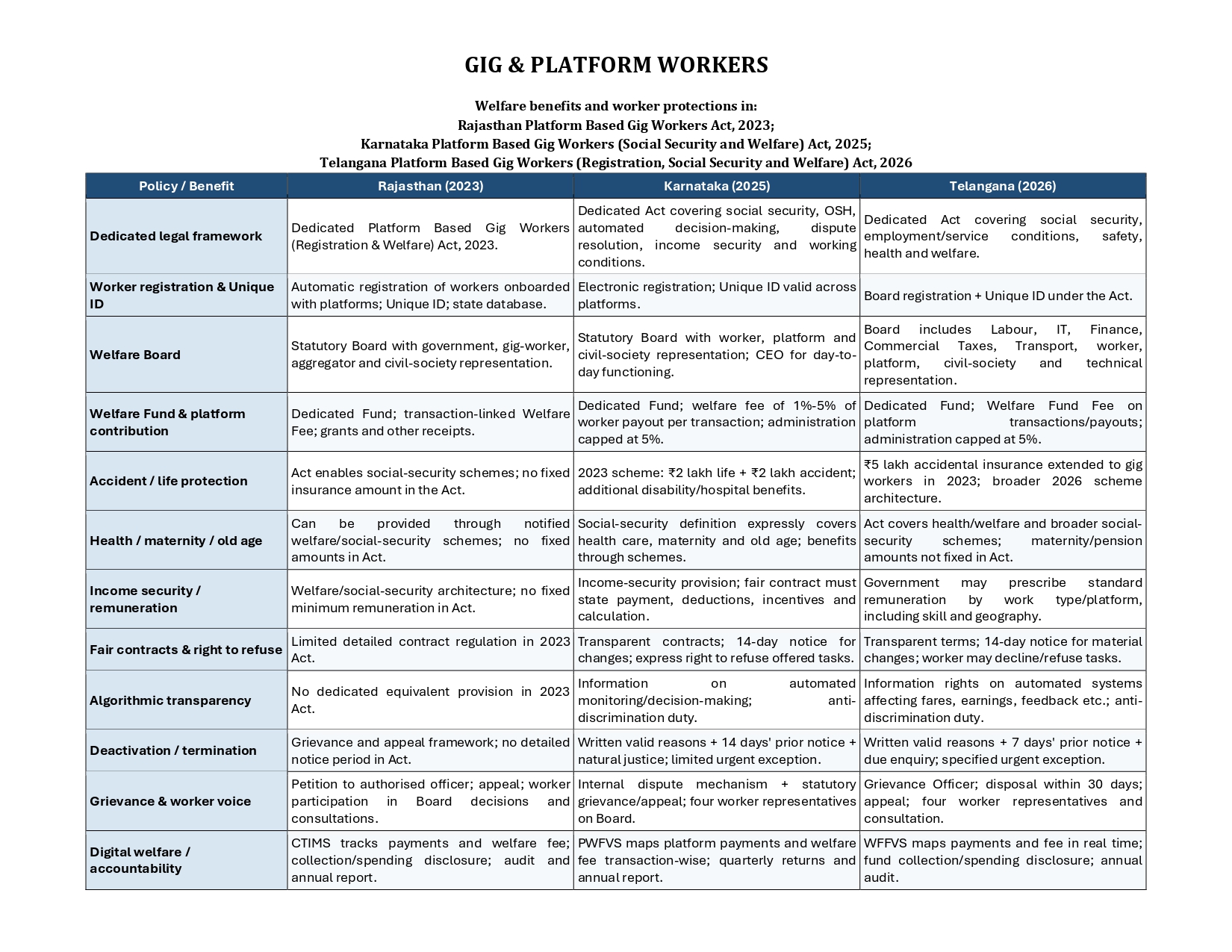
Historic Legislative Efforts for Social Security in Rajasthan, Karnataka and Telangana
Millions of gig workers play an important role in advancing India’s digital economy. Delivery partners and cab drivers associated with Swiggy, Zomato, Uber, Ola and other online platforms have long been facing challenges such as employment insecurity, the risk of accidents, lack of social security and arbitrary practices by companies.
To address these challenges, the Congress governments of Rajasthan, Karnataka and Telangana have taken important initiatives through specific legislation aimed at providing social security and welfare to gig workers.
1. Rajasthan: The First Legal Initiative in the Country
In 2023, the Congress government led by the then Chief Minister Shri Ashok Gehlot enacted the country’s first Rajasthan Platform Based Gig Workers (Registration and Welfare) Act.
The law provides for the registration of gig workers, establishment of a Welfare Board, creation of a Social Security/Welfare Fund and a grievance redressal mechanism. It also provides for collecting a welfare fee from platform companies to mobilise resources for the protection and welfare of workers.
Key Features:
• Registration of gig workers and aggregators and issuance of a Unique ID.
• Establishment of a Gig Workers Welfare Board.
• A separate Welfare Fund for gig workers.
• Provision for collecting a Welfare Fee from aggregators.
• A legal framework for social security and welfare schemes.
• Grievance and appeal mechanisms for workers.
• Representation of workers on the Welfare Board.
• Online registration and digital mechanisms for providing welfare benefits.
Download: Copy of the Act
2. Karnataka: Social Security Along with Transparency
The Congress government led by Chief Minister Shri Siddaramaiah enacted legislation in 2025 for the rights and welfare of gig workers.
The Karnataka Platform-Based Gig Workers (Social Security and Welfare) Act, 2025 received the Governor’s assent on 11 September 2025 and is deemed to have come into force from 30 May 2025.
Karnataka Gig Workers Act, 2025 — Key Features
• Unique ID: Every registered gig worker is provided with a unique identification number that is valid across platforms.
• Welfare Board: A Welfare Board comprising representatives of gig workers, platforms/aggregators and civil society.
• Social Security & Welfare Fund: A dedicated fund for providing social security benefits to gig workers.
• 1%–5% Welfare Fee: Aggregators are required to contribute a welfare fee ranging from 1% to 5% of the payout made to the worker for each transaction.
• Health and Social Security: Provision for schemes relating to healthcare and income security.
• Fair Contracts: Provision for clearly disclosing information regarding payments, deductions, incentives and other contractual terms.
• Right to Accept or Reject Work: Workers have the right to accept or reject a work assignment offered to them.
• Algorithmic Transparency: Workers have the right to information regarding ratings, earnings, fares and automated decision-making systems that affect their work.
• Protection Against Deactivation: A platform must provide written reasons for deactivating a worker and, generally, give 14 days’ prior notice.
• Grievance Redressal: Provision for internal dispute resolution, grievance redressal and appeals.
• Digital Monitoring: Payments made to workers and welfare fees are tracked through the Payment and Welfare Fee Verification System (PWFVS).
In Summary
The Karnataka law is not limited to the creation of a Welfare Fund. It also incorporates worker rights relating to social security, fair contracts, procedures for deactivation, algorithmic transparency and grievance redressal.
Download: Copy of the Act
3. Telangana: Legal Recognition and Welfare Rights for Gig Workers
The Congress government led by Chief Minister Shri A. Revanth Reddy enacted legislation in 2026 for the registration, social security and welfare of gig workers, which came into effect on 2 June 2026.
The law provides for a Unique ID for every worker, a Welfare Board, a Social Security and Welfare Fund, grievance redressal mechanisms and accountability of platform companies. A registration system has also been established to enable workers to access various welfare schemes.
Telangana: Key Features for Gig Workers
• Legal Recognition: Provision for registration of all gig and platform workers and issuance of a Unique ID.
• Welfare Board: Establishment of a separate Social Security and Welfare Board for gig workers.
• Welfare Fund: Provision for collecting a contribution of 1%–2% from platforms/aggregators on each transaction to create a welfare fund.
• Social Security: Provision for accident insurance, health/insurance assistance, pension, maternity benefits and other social security schemes.
• Minimum Wages: From June 2026, provisions relating to wages were implemented to bring gig workers within the scope of minimum wage protections in Telangana.
• Grievance Redressal: A formal mechanism for resolving workers’ grievances.
• Algorithmic Transparency: Workers have the right to seek information regarding automated decision-making systems that influence work allocation, payments, ratings and other aspects of their work.
• Representation of Women and Persons with Disabilities: Provision for representation of women and persons with disabilities in the welfare framework.
• Aggregator Accountability: Registration of platform companies and mandatory welfare contributions, with penalties for violations.
• Digital Records: The government has also emphasised the creation of a comprehensive digital database of gig workers.
In Summary
The Telangana model focuses on:
“Legal Recognition of Gig Workers + Unique ID + Welfare Board + Welfare Fund + Social Security + Platform Accountability.”
Download: Copy of the Act